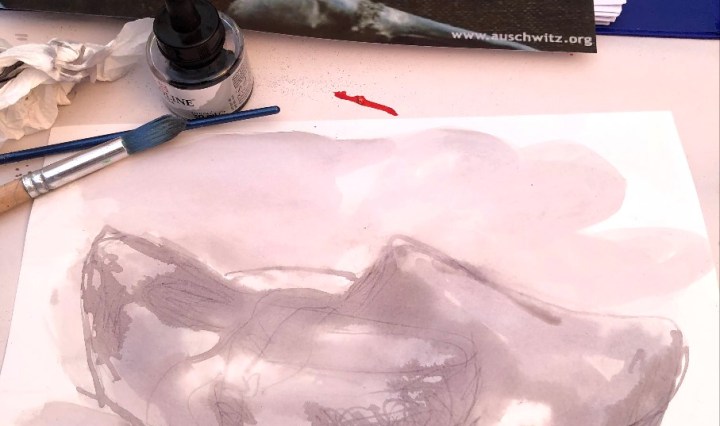
“Would I say this was good if I didn’t know it was a Pollock?”

So what’s this about? To some extent, it’s a follow-on from Brian Eno’s discussions on the matter of art and how to classify and value it. His thesis is that, so long as there is no taxonomic model for positioning different kinds of creative art (the things we do that we don’t need to do – like hair styles), value will always be dictated by a few people at the top who have established a reputation and a kind of provenance by being in the right place with the right people at the right times. This can only lead to … Continue reading “Would I say this was good if I didn’t know it was a Pollock?”

Brian Eno on art, value, and culture

This is from my other blog and comprises a critique of Eno’s lecture to the AA School of Architecture while acknowledging the initial questions Eno asks and his stated premise. Brian Eno’s lecture to the AA School of Architecture takes on the problem of how to talk about, to write about, to classify and describe art. Or that was the plan. The lecture starts well with the idea that the arts – all of them – are everything you don’t have to do as illustrated by screwdrivers. The business end is a fixed design, functional and with no room for … Continue reading Brian Eno on art, value, and culture

“Art is everything you don’t have to do” – Brian Eno

Brian Eno’s lecture to the AA School of Architecture takes on the problem of how to talk about, to write about, to classify and describe art. Or that was the plan. The lecture starts well with the idea that the arts – all of them – are everything you don’t have to do as illustrated by screwdrivers. The business end is a fixed design, functional and with no room for manoeuvre, but the handle – that can be plain, striped, blue, red, yellow, pink, fat, thin, shaped, pared down. The business end is what you have to do, the handle … Continue reading “Art is everything you don’t have to do” – Brian Eno

Part 2, Research point – collections and materials

Tabitha Moses: http://www.tabithamoses.co.uk/page36.htm The web page above, the artist’s own, has been somewhat unreliable as a source; quite often failing to load. Other sources are variable but the overriding message is that she is focused on fertility and uses a great deal of stitch work in her art. Some pieces are satin limbs dotted with sequins or pins and representing the discomfort of eczema or other skin diseases. It is very emotive work that seems driven by Moses’s own experiences. This is from an exhibition/talk in 2019: Tabitha Moses practices at the intersection of art, health and wellbeing; drawing on … Continue reading Part 2, Research point – collections and materials

Assignment 2 with AR via QR – blue butterflies anyone?

This very primitive demonstration shows how augmentation can be applied to paintings wherever they are and accessed using QR scanning. A second way of making the AR visible is to upload the target image, in this case the painting, and the video file – this one made in Thyng – to the Thyng website. Once live, scanning the image with the Thyng app will bring up the AR embedded video. QR scanners are ubiquitous for smart devices. Thyng may be a new um, thing but is also a smart device app. This is an experiment; I’m paddling in the shallows … Continue reading Assignment 2 with AR via QR – blue butterflies anyone?
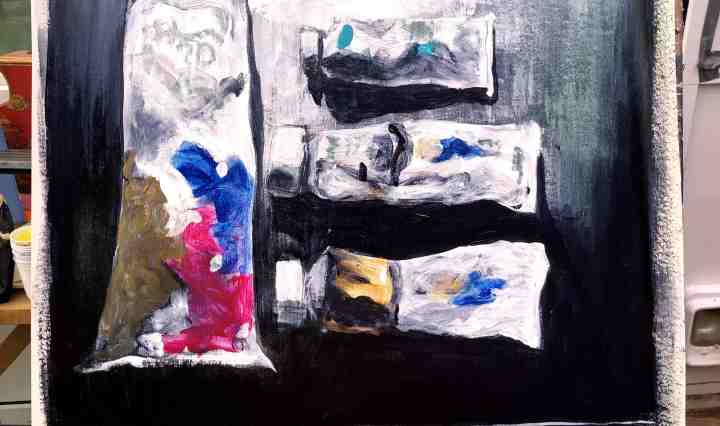
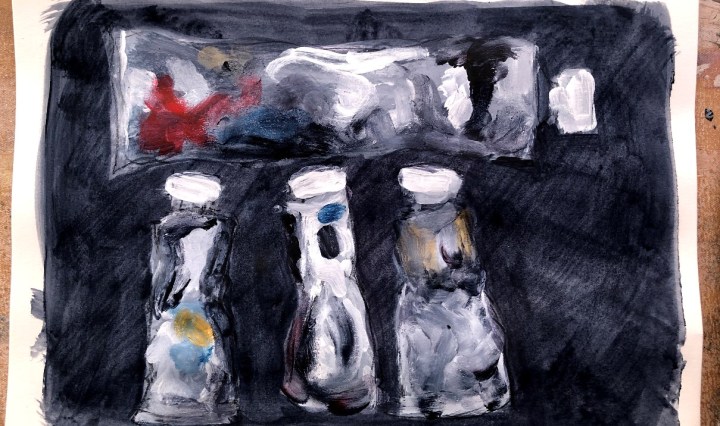
Part 2, Research point – unusual materials

I have steered round the materials I find uncomfortable; food items for instance which seems profligate and irresponsible at a time people are having to rely on food banks, and in fact when many of us experienced food insecurity for the first time in our lives as shops emptied, supermarkets had no delivery slots, and staples like flour disappeared for months. I’ve also skipped materials that give off fumes because, however interesting they might be, I am unlikely to use those products. This meant going on a search of my own for artists who use unusual materials to make their … Continue reading Part 2, Research point – unusual materials