


Lockdown art #One
Strange times, as they say. I’m lucky to have a garden because I’m likely to be confined to it for some while yet, but fulfilling some of the requirements of a Painting degree has been a challenge. Models/sitters? Exhibitions? Plein … Continue reading Lockdown art #One

Side project – paint a Rothko
Again this is prompted by the Coursera course on abstract art. I baulked at Pollock and de Kooning, both of them a little too unconstrained for my circumstances, but thought this would be a doddle. It wasn’t and I had a day of muddy failures on an 8″ x 10″ canvas board. In addition to lack of actual skill, the key issues seemed likely to be the medium and the support – his oils (with linseed and turpentine) on canvas, mine acrylics on a small canvas board with pva glue and some medium that slows drying. So after a day … Continue reading Side project – paint a Rothko
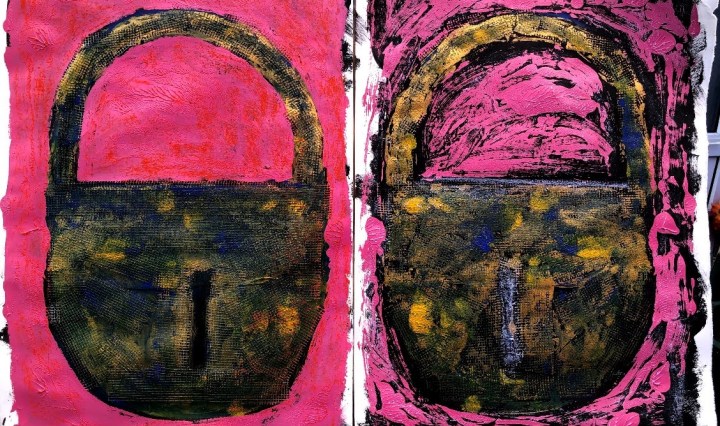
Part 5 – second wave locks and keys sketches
I discovered quite a lot about shapes and surfaces yesterday so that was a good start. Later I began to think about what lockdown meant in practical terms and how an image of a lock might illustrate or represent this. … Continue reading Part 5 – second wave locks and keys sketches
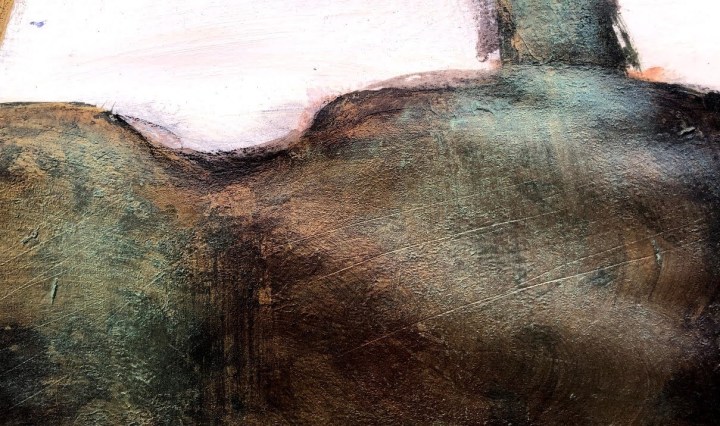
Part 5 – first preliminary paint sketches
The first page of this section advises looking at the assignment before going any further, presumably to help direct our thinking around the various exercises that build up to it. The task is to make a series of three to … Continue reading Part 5 – first preliminary paint sketches

Side project – paint a zip
I am following a Coursera course on modern art which has just been discussing Barnett Newman’s (1905-1970) ‘zip’ paintings. According to the MoMA site: His zips streak through fields of color in spare compositions that prompted critics to dub him … Continue reading Side project – paint a zip
Part 5, research point 2, AbEx – the missing women and people of colour
I had just posted my piece on abstract expressionism, noting the missing women, when I found this article on Artsy net. Alongside a very accessible article about what you need to appreciate abstract art – it turns out you need to know something of the context, the historical background, provenance, and the cultural realities artists were working in. Also their significance as innovators – was a short paragraph concerning the missing women. “The truth is I did not set out to do a women’s show; I really set out to see who’d been left out of the canon of Abstract … Continue reading Part 5, research point 2, AbEx – the missing women and people of colour

Part 5, research point 2 – abstract expressionism and tachism
I had to look up abstract expressionism and discovered it was a movement that arose from a group, largely of men, whose aim was to shift the post-WWII balance of contemporary art from Paris to New York. Titled the New … Continue reading Part 5, research point 2 – abstract expressionism and tachism

Part 5, research point 1 -application of paint
A glance at the work of different artists is sufficient to see that there are many different ways to apply paint to a canvas. In my own experience, I’ve found this differs even with different supports – methods that have … Continue reading Part 5, research point 1 -application of paint

Part 5, project 3, exercise 2 – abstract from manufactured forms
I suddenly recalled seeing a series of drawings of a bull by Picasso whereby he had gradually reduced its form from naturalistic to the barest of essential elements. Because I hadn’t seen that before, I’d had no real sense of … Continue reading Part 5, project 3, exercise 2 – abstract from manufactured forms
 Strayfish Arts