Curiosity, memory, and implicit learning

Curiosity I have never been interested in history of any flavour and so I’ve struggled to find hooks in art and art history on which to hang information pertinent to my own work. In particular, identifying artists who might have influenced what I’m doing and the way I’m doing it leaves me blank. To remedy this, I have followed up recommendations of artists to look at, bought and read books describing developments in art history, and tried almost to manufacture post hoc the required ‘influences’. This article may describe one reason to account for this: because I have almost no … Continue reading Curiosity, memory, and implicit learning
Creativity – a podcast from the British Psychological Society

This is my professional body so I can vouch for its credibility. That said, this podcast is a very quick skim through the cognitive neuropsychology of creativity so it doesn’t cover anything in detail. The main takeaways though are: Experience novelty as much as possible Practice – both being creative by problem solving [and questioning things], and technique. Step away from whatever you’re working on and take some time out. Doing something mundane like washing up or walking that doesn’t involve too much cognitive effort frees up your brain to work on problems under the surface. We all recognise that … Continue reading Creativity – a podcast from the British Psychological Society

Part 4, project 6, exercise 3 – portrait

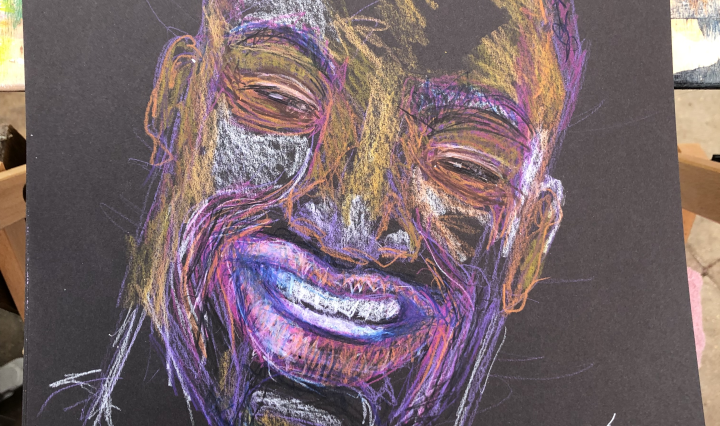
Task: a portrait from memory or imagination. Not so long ago I would have looked at this with joy and relief. Now, after struggling to make sense of what I see in front of me and realising the advantages that confers in terms of perspectives and all those unevennesses faces have, I’m glaring at the instruction with an expression somewhere between disbelief and horror. Someone I saw in passing? A person I used to know? A character from a book? Strange how that wipes every conceivable memory and drops my imagination through a trapdoor so that I can’t even remember … Continue reading Part 4, project 6, exercise 3 – portrait

Part 4, project 6 – research point #2

Historic and contemporary self portraits. I chose Rembrandt and van Gogh as my historic examples (then read that they were recommended) because of their very different approaches. I particularly liked Rembrandt’s honesty with regard to his image when he was older; the unvarnished truth of it and the lack of glamour. His style is very much about realism, these were the instagrams of the day, the selfies, and many of his clients paying for commissions were likely to require a very positive image of themselves and their surroundings. Van Gogh, an insular man with some enormous troubles, painted fractured images … Continue reading Part 4, project 6 – research point #2

Part 4, project 6 – research point #1

Contemporary and historic artists working in different ways on the head. See in particular Graham Little and Elizabeth Peyton. Extraordinarily, Little has no Wikipedia entry and doesn’t appear in any of the books I have to hand. An internet search brings up gallery reports, blogs, and news items, with The Guardian in 2010 introducing his Artist of the Week slot thus: The women in Graham Little’s virtuoso drawings inhabit a world of sumptuous beauty. Realised in a muted Merchant Ivory palette, these long-limbed belles recline gracefully in designer interiors. This is an 80s world of midnight-blue suits and earth-coloured bed sheets, of … Continue reading Part 4, project 6 – research point #1

Moving figures, research point Angela Edwards

A local gallery has sent out notifications of a forthcoming exhibition of cityscapes and I’ve seen for the first time the works of Angela Edwards, a contemporary artist. This is a short video of one of her pieces as she puts it together.   The gallery is Kellie Miller Arts in Brighton which I visited earlier in the summer and which I intend to visit again to see these pictures close up. The link leads to the gallery’s page showing thumbnails of Edwards’s work. Also showing is a selection of Marco Minozzi’s atmospheric townscapes in which there are no figures … Continue reading Moving figures, research point Angela Edwards