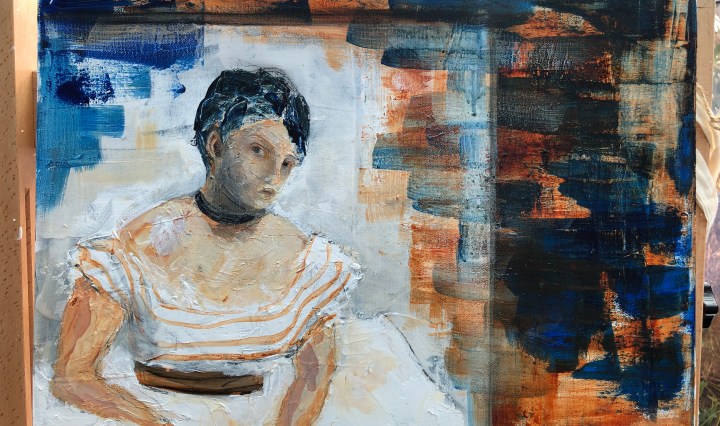
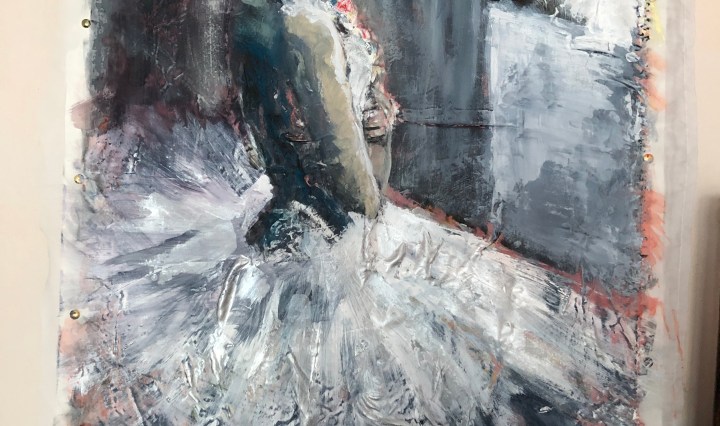
‘Backstage’
Painting after a photograph by Gerard Ufera, with permission. Continue reading ‘Backstage’
Remember this from the previous post? The ballet fail that I exorcised with a large dollop of white primer? Well, I’m taking another run at light, this one based on a photo reference because it’s clear that imagining how bodies … Continue reading Light revisited
Organisationally tricky to integrate and take from one blog to another, I may just make this a cumulative post and take the link forward. Secrets of dust – pastels with Tom Walker PS via Mall Galleries. Pastel demonstration by Tony Allain PS, also via Mall Galleries. Watercolour demonstration by Brian Smith RI. Via Mall Galleries. Introduction to Intellectual Property and Copyright – Lisa Moore and Marie Hounsome for OCA. 10/03/2021. Due to be posted on the university site. Oil demo of an urban landscape by Adebanji Alade VPROI. Via Mall Galleries. Continue reading Webinars, video demonstrations/tutorials
6th March. Pursuing the ballet theme because I’m beginning to get a feel for the shapes, the colours, and the way light works in backstage/onstage contexts. This time there is no reference photo or painting although I did use one … Continue reading More light
Last time I took a pop at painting light, I copied and then updated a Degas. This time, I’ve taken a photograph I found that purports to be backstage at the Bolshoi although for now I can’t confirm that or … Continue reading Light, again
Assignment 5, on the theme of environment, comprises five pairs of paintings following the demolition and rebuilding of my conservatory/studio over four months in 2020/21. The pairs further comprises a primary painting and a folded print of that piece as individual layers or blocks of paint were applied; and each pair reflects a different stage in the build. By evolution rather than predetermined plan, the pairs also reflect different artistic influences from Chinese to architectural. These are accompanied by texts – the ones on the painting tending towards the more pragmatic or factual, and on the print, rather more mystical … Continue reading Assignment 5: final images and animations
This assignment was, for me, the best part of the module. Expansive and liberating, it contrasted sharply with the more insular and prescriptive exercises that preceded it but which, nevertheless, I was able to employ in this series of paintings. … Continue reading Objective Evaluation
A factor we’re asked to consider for Assignment 5 is curation – how to display or present our work and what might inform our choices. We’re pointed to a number of artists for examples of how they have curated their own work as a guide. The difficulty I found when following this up was that none, if they had one person exhibitions at all, had curated the content, and most had only one piece of work on show in any given gallery. Nevertheless, the principles still apply – what order (temporal, thematic, drama, palette, size, message impact), what background (I … Continue reading Curation
Brief: look at three of the artists listed in the course materials. Before I began this task, I listed all the artists provided in the course materials and located websites with information and images. I did this over time, only at this final point eliminating the ones I had found least engaging, thereby leaving me with these three. At this point, I realised that all of them are mixed media, they all take discarded or found objects of some kind as their subject matter, and they all project a profound sense of meaning even if they are not always forthcoming … Continue reading Part 5, research point
Acrylics – democratising art practice? Until the early 20th century, artists had been working with the same painting materials for hundreds of years …. [t]hen in the 1940s and 50s acrylic paint burst upon the art scene. Artist’s Manual. Collins … Continue reading Part 5, essay – historical and contemporary use of acrylics*