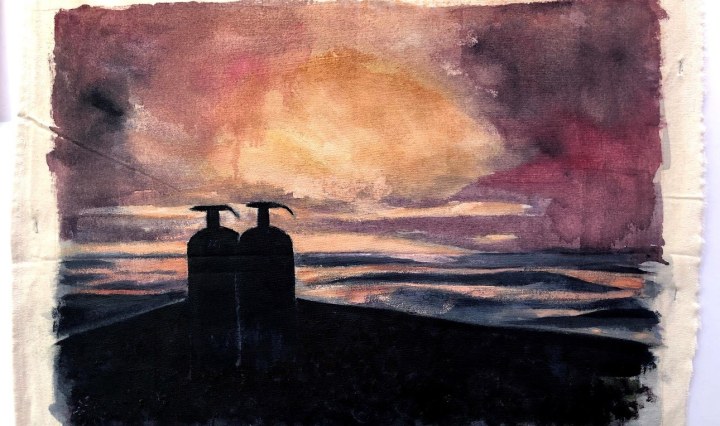
Drawing or painting; painting or drawing?

For my final assignment I found I really wanted to execute this in acrylics; but was this drawing, and if it wasn’t, what made it different? Intuitively, I could see no real difference, especially as somewhere in Drawing1 I was being asked to ‘paint with pastels’, while in Practice of Painting at least one exercise is about ‘drawing with paint’. If I draw in the traditional sense, it is with an implement that on the whole is short and resilient, while if I paint I am using a tool that is often longer and has a flexible component at the … Continue reading Drawing or painting; painting or drawing?

Formal Assessment – images

This is a detail from my sketchbook; drawings of metallic birds in biro, and watercolour finger-painted into place. The support is pink sugar paper pasted into the book. It was probably the first time I had made loose drawings of this kind and it came after buying a copy of Henry Moore’s book full of ‘wire frame’ drawings of sheep. I think this series of drawings represents something of an early milestone in exploration of different media and supports as I had never used either before. My approach to drawing had also changed in this work, looser and less ‘perfect’. … Continue reading Formal Assessment – images

How to paint like Picasso – video

I am a sucker for idiot’s guides to areas I have little or no grasp on, and while I’d read somewhere about cubism being derived from an attempt to represent many rather than just one perspective, having that idea visualised for me makes a big difference. Don’t make the mistake though of thinking this is a demonstration of how to copy one of Picasso’s pieces of work, it isn’t, it’s the equivalent of a singer/songwriter using Bob Marley’s riffs and rhythms in a new song, rather than someone you never heard of covering ‘No Woman, No Cry’. The art work … Continue reading How to paint like Picasso – video

Part 3, research point 3 – figures in interiors

Fitting the brief of paintings that appeal to me, I went first for Degas and his dancers in studio contexts. That led inevitably to his antithesis, Paula Rego and her dancing ostriches which are altogether less delicate. Stuck a little in ‘dancer’ mode, I spotted a painting by someone called Colin whose figures are very nearly symbolic (and which may or may not be in an interior setting), then I pursued the brief in more modern terms with a piece by Grayson Perry which is a crowded and cluttered interior which is recognisably a ‘today’ scene , and finally a … Continue reading Part 3, research point 3 – figures in interiors

Part 3, research point 2 – portraits conveying mood or atmosphere + Fauvism & German Expressionism

This task points up some of the artists who have illustrated mood above likeness. Picasso’s blue paintings for instance; van Gogh’s early paintings of peasants, and the way Rembrandt used tonal contrast in a restricted palette to pull out a person’s mood and personality. After looking at these, the task then asks us to compare them with Fauvist painters and with German Expressionism. This requires some serious internet searching, but the artist who comes immediately to mind is Bisa Butler who, arguably, is as much about mood – in this case pride and the assertion of the right to be … Continue reading Part 3, research point 2 – portraits conveying mood or atmosphere + Fauvism & German Expressionism