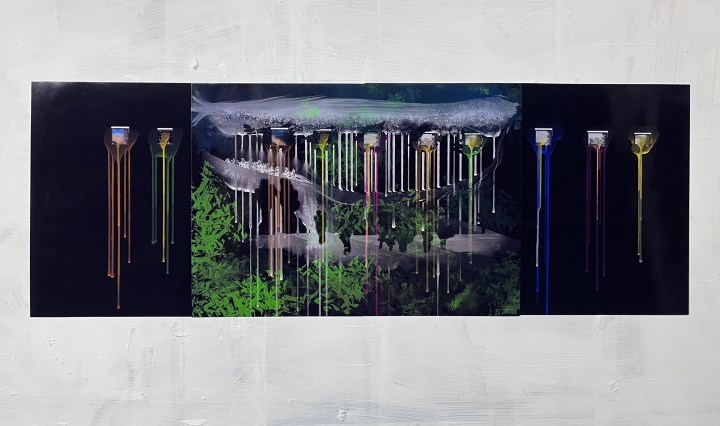
Option 1, exercise 1.2: the digital

I’m calling this exercise 1.2.1 because there is going to be at least one more. This exercise builds on appropriation and collage, introducing the notion of the glitch and informed by, for example, Gordon Cheung. I was more than pleased to see that I could use primarily digital methods in the making of the images. I used three random screengrabs; one of a zoom meeting about book cover design run by the Edinburgh book festival last year, the second of a spider’s web across the live stream webcam at Porthcawl pier, and the third of a google search for ‘obliteration’ … Continue reading Option 1, exercise 1.2: the digital

Back to Option 1 – the edit and the digital

Project 3 focuses on Donna Haraway, an American scholar noted for many things but primarily in this context, her 1984 ‘A Cyborg Manifesto: Science, Technology, and Socialist feminism in the Late 20th Century’ in which she argues that all of us in, (at the time), western societies have become so integrated with technology that the distinction between humans and machines is blurred. That was a prescient view, given the actuality of technological integration at the time. Unfortunately, none of the referenced texts is available via the links in the course materials but there is a plethora of video material, including … Continue reading Back to Option 1 – the edit and the digital
Research point Option 1 – Gordon Cheung (1975-)

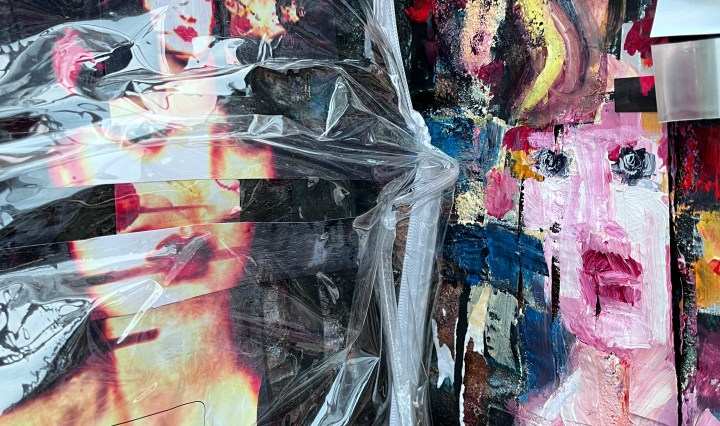
Unfortunately, the link to a text in the course materials, this one titled Colart Loved By: Gordon Cheung, is dead but the video article is not and so I am relying on that and articles found in a search for Colart. This is from Elephant which seems to be a magazine: “London-based artist Gordon Cheung discusses his tools of choice: a computer, spray gun and paint. You can find out more about Colart’s Loved By campaign, which launches this weekend [January 2018] at Creative World in Frankfurt.” https://elephant.art/colart-loved-by-gordon-cheung/ In the video, Cheung talks about substituting other materials for paint – … Continue reading Research point Option 1 – Gordon Cheung (1975-)

Project 2: replaced in this series by Project 1, Option 2.

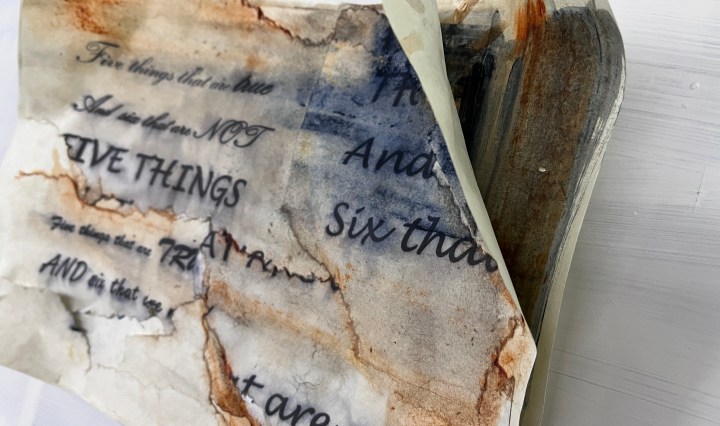
This would be assemblage but I am not best equipped for manipulating objects and so I am swapping it out for Project 1 of Option 2: narrative and appropriation. And while there is in theory an element of appropriation, the core theme is the use of a meaningful pre-existing story. This plays directly into my submission goal; a series of paintings embodying key elements of a pre-existing short story and, the task being to produce around 10 paintings for the linked exercise, it can serve as preparation and exploration for that. First, there is the research to underpin the theme, … Continue reading Project 2: replaced in this series by Project 1, Option 2.

Project 2 Physical texture – assemblage and the reconnection of disparate parts

Jean Dubuffet (1901-1985) Dubuffet “advocated for “instinct, passion, mood, violence, madness”2 rather than analysis and reason, as well as closer proximity to nature and natural forms and the discarding of traditional notions of beauty. “Look at what lies at your … Continue reading Project 2 Physical texture – assemblage and the reconnection of disparate parts

Exploring Media: level 2 (HE5), second module

This is in effect a legacy module as the course is being re-vamped and reorganised. The last of the 60 credit courses at this level, it is in ‘teaching out’ mode until everyone enrolled on it has moved on. Hereafter, there will be three 40 credit units as there are at level 1 (HE4). Reading the course materials, it’s immediately obvious that the structure is completely different from previous modules. The Assignments are not specific to Parts but apply to progress through Options, of which there are four. We make a choice of two from these four but there is … Continue reading Exploring Media: level 2 (HE5), second module