With alarming warnings about wild fires, and government alerts to our phones, I’m safeguarding a draft copy my last piece of written work by posting it here. Everything else that I might submit to assessment is already online and so would be available in the event that the local copies are lost. The piece is unedited and therefore exceeds the required word count.
DRAFT 1
Summary, end of Unit/course
I began this degree towards the end of 2018 when the OCA was a rather informal, not-exactly-online standard distance course. I wasn’t clear what the units were about, and the timings seemed somewhat relaxed, but I do recall the absolute horror of packing up my best work and sending it off by post to Barnsley for assessment. Would it get there and what if it didn’t? Online was an admin detail, not a learning environment.
Then came COVID when the whole world went online and Zoom came into being. For a small, poorly funded course, the OCA stepped up to the challenge in very short order, giving us video meetings, workshops, guest speakers, online tutorials, and digital assessment so quickly it was as if these things had been there all along, just waiting to be let loose. I don’t think I’ve ever seen an academic institution move so fast and with such competence.
I benefited hugely from this new accessibility and the closer relationship with tutors who, throughout COVID, ran online workshops, groups, and tutorials from a standing start. If ever an organisation could be said to have pulled on its big girl pants, it was the OCA and it did that with style.
It’s hard to quantify what I’ve learned over these last years, partly because the changes have been qualitative which in themselves enabled other qualitative changes. (see Adjacent possibilities, the requirement of one process or idea for another process or idea to be present before a new level of function to emerge). But I can identify particular points such as believing that ‘getting the thing done’ and moving on was more important than sitting with it until something moved past what I expected to see into what I was actually seeing, and that need some attention. One dab of paint or one line could make the difference between feeling satisfied with a piece or not, and I wouldn’t have noticed this, intellectually, visually, or conceptually before this constant learning by immersion over a long timespan.
I’ve spoken before about how skills are learned as explicitly conscious routines, cognitive and physical, before sliding into conceptual wholes stored unconsciously and requiring no thought to activate. This is what time achieves and it’s how that need for a dab of paint or a line can come seemingly from nowhere and appears not to be driven by thought.
Throughout these years, I’ve been supported by practising artists with demonstrable skills in guidance and the critiquing of fragile new skills; and although I take full responsibility for my output, I absolutely acknowledge the below-the-water-line duck paddling that each tutor achieved to get me into the position I find myself.
And where is that? To be clear, I see myself as an about-to-be graduate and not a sudden expert in painting. I’m taking and hopefully passing, the equivalent of my driving test and it will be a while before I can consider myself much more than just safe to let out on the road. Critically though, I have the skills to gather more skills (adjacent possibilities again) by looking, seeing, and accessing additional courses. I’m interested in film and animation, and painting gives me a framework by which to pursue these interests. During this course and because of the freedom it allowed me, I’ve learned how to make moving images form my own paintings and to develop these into augmented reality layers accessible via the Artivive app. I’ve since begun to add sound effect tracks using both material recorded in my own environment and also using a keyboard. This means I can produce the entire piece of work without the risk of breaching copyrights.
I couldn’t have done this without the freedoms the OCA gave me to invent, to go off-piste and to paint with both physical materials and collage and also with the digital structures offered me by MotionLeap, PhotoDirector, and Cyberlink where every change that isn’t photographic and so not novel, is made by hand. Where something moves, I’ve drawn the motion patterns that make this happen. These extended skills for the basis of my augmented reality work – layers that sit on top of an original piece and confer additional qualities.
My background is in psychological science that, due to my clinical area of practice, drew on many of my own life experiences and helped me weave these into clinical experiences that enhance empathy. All of this underpins y thinking about the work I do now and probably explains my tendency to hop form one set of ideas to another rather than pursuing a more sustained series. Difference is built into clinical practice because every client is different, and I wouldn’t see this as short-termism, more the essential skill of seeing round corners and holding something in mind until it’s needed.
This degree is my full circle as regards art. A Foundation year dropout coming back after almost six decades to finish what I started and to integrate this with everything else that makes me me. I know more about how to look at things and how to actually see them. How to think and talk about them, and how to understand why I think something works or doesn’t. Objectivity is critical and the term ‘murder your darlings’, with which most writers are familiar, applies as much here as there.
There is a quantity of thanks due to everyone who’s helped me along the way. It includes every tutor I’ve encountered, and Emma Drye who has headed up that team with empathy and insight Of these, Clare (Wilson) has seen more of my work than anyone else and kick-started many a stalled creative engine. Worthy of the boom-tish of gratitude for a job well done and very much appreciated.
Whatever else I might have achieved via this course, I have a better sense of what it is to be an artist and how that can be integrated into the toolbox of skills I’ve collected along the way is my job to do and I feel well-prepared to do it.
Apart from selling; I’m never going to like selling!
1017 words/750 allowed excl title and refs
© Suzanne Conboy-Hill 2026
Adjacent possibilities
DRAFT 2
End of Unit/Course: Summary
image
I began this degree towards the end of 2018 when the Open College of the Arts (OCA) was a rather informal, only partially online, standard distance course. I wasn’t clear what the units were about, and the timings seemed somewhat relaxed, but I do recall the absolute horror of packing up my best work and sending it off by post to Barnsley for assessment. Would it get there and what if it didn’t? Online was an admin detail, not a learning environment.
Then came COVID when the whole world went online and Zoom came into being. For a small, poorly funded course, the OCA stepped up to the challenge in very short order, giving us video meetings, workshops, guest speakers, online tutorials, and digital assessment so quickly it was as if these things had been there all along, just waiting to be let loose. I don’t think I’ve ever seen an academic institution move so fast and with such competence.
I benefited hugely from this new accessibility and the closer relationship with tutors who, throughout COVID, ran online workshops, groups, and tutorials from a standing start. If ever an organisation could be said to have pulled on its big girl pants, it was the OCA and it did it with style.
It’s hard to quantify what I’ve learned over these last years, partly because the changes have been qualitative which in themselves enabled other qualitative changes. (see Kaufman, S. 2024 on Adjacent Possibles) the requirement of one process or idea to be present alongside another for a new level of function to emerge). But I can identify particular points such as believing that ‘getting the thing done’ and moving on was more important than sitting with it until something in the painting called for attention. One dab of paint or one line could make the difference between feeling satisfied with a piece or not, and I wouldn’t have noticed this, intellectually, visually, or conceptually before this constant experience of learning by immersion.
I’ve spoken before about how skills are learned as explicitly conscious routines, cognitive and physical, before sliding into conceptual wholes stored unconsciously and requiring no thought to activate. This is what time achieves and it’s how that need for a dab of paint or a line can come seemingly from nowhere and appear not to be driven by thought. ref
Throughout these years, I’ve been supported by practising artists with demonstrable skills in guidance and the critiquing of fragile new skills; and although I take full responsibility for my output, I absolutely acknowledge the below-the-water-line duck paddling that each tutor achieved to move me into my current position.
And where is that? To be clear, I see myself as an about-to-be graduate and not a sudden expert in painting. I’m taking, and hopefully passing, the equivalent of my driving test and it will be a while before I can consider myself much more than just safe to let out on the road. Critically though, I have the skills to gather more skills (adjacent possibilities again) by looking, seeing, and accessing additional courses. I’m interested in film and animation, and painting gives me a framework by which to pursue these interests.
During this course, and because of the freedom it allowed me, I’ve learned how to make moving images from my own paintings and to develop these into augmented reality layers accessible via the Artivive app. I’ve begun to add soundtracks using material recorded in my own environment and also with an Akai keyboard. This means I can produce the entire piece of work without risk of breaching copyrights.
I couldn’t have done this without the freedoms the OCA gave me to invent, to go off-piste and to paint with both physical materials and collage and also with the digital structures offered me by MotionLeap, PhotoDirector, and Cyberlink where every change that isn’t photographic is made by hand. Where something moves, I’ve drawn the motion patterns that make this happen. These extended skills form the basis of my augmented reality work – layers that sit on top of an original piece, conferring additional qualities.
Image
My background is in psychological science that, due to my clinical area of practice, drew on many of my own life experiences and helped me weave these into clinical experiences that enhance empathy. All of this underpins my thinking about the work I do now and probably explains my tendency to hop from one set of ideas to another rather than pursuing a more sustained series. Difference is built into clinical practice because every client is different, and I see this not as short-termism, but the essential skill of seeing round corners and holding something in mind until it’s needed.
This degree is my full circle as regards art. A Foundation year dropout coming back after almost six decades to finish what I started and to integrate this with everything else that makes me me. I know more about how to look at things and how to actually see them. How to think and talk about them, and how to understand why I think something works or doesn’t. Objectivity is critical and the term ‘murder your darlings’, with which most writers are familiar, applies as much here as there.
There is a quantity of thanks due to everyone who’s helped me along the way. It includes every tutor I’ve encountered, and Emma Drye who has headed up that team with empathy and insight. Of these, Clare (Wilson) has seen more of my work than anyone else and kick-started many a stalled creative engine. Worthy of the boom-tish of gratitude for a job well done and very much appreciated.
Whatever else I might have achieved here, I have a better sense of what it is to be an artist, and integrating this into the toolbox of skills I’ve collected along the way is my next job to do and I feel well-prepared to do it.*
989 words/750 +/- 10% (825) allowed excl title and refs 164 words to lose
Adjacent Possible. Bjorneborn, L. 2023. In: The Palgrave Encyclopedia of the Possible (pp 16-28). https://www.researchgate.net/publication/367416541_Adjacent_Possible
Stuart Kaufman, The Adjacent Possible and how it explains Human Innovation. Video. 2024. https://www.youtube.com/watch?v=nEtATZePGmg
*Apart from selling; I’m never going to like selling!
DRAFT 4 – or perhaps 5
Ok, 3
End of Unit, end of course: a summary
I began this degree towards the end of 2018 when the Open College of the Arts (OCA) was rather informal and only partially online. I recall the horror of packing off my best work to Barnsley for assessment. Would it get there and what if it didn’t? Online was an admin detail, not a learning environment.
Then came COVID when the whole world went online and Zoom came into being. For a small, poorly funded course, the OCA stepped up to the challenge in very short order, giving us video meetings, workshops, guest speakers, online tutorials, and digital assessment so quickly it was as if those things had been there all along, ready to be let loose. I don’t think I’ve ever seen an academic institution move so fast and with such competence.
I benefited hugely from this new accessibility and the closer relationship with tutors who, throughout COVID, provided a digital learning environment from a standing start. If ever an organisation could be said to have pulled on its big girl pants, it was the OCA.
It’s hard to quantify what I’ve learned over these years, partly because the changes have been qualitative which in themselves enabled other qualitative changes. (see Kaufman, S. 2024 on Adjacent Possibles). But I can identify particular points such as realising that ‘getting the thing done’ and moving on was much less important than sitting with it until something in the painting called for attention. One dab of paint could make the difference between feeling satisfied with a piece or not, and I wouldn’t have noticed this, intellectually, visually, or conceptually, before this constant experience of learning by immersion.
At its most basic level, skills are learned as explicitly conscious routines before becoming conceptual wholes stored unconsciously and requiring no thought to activate [see Pardoe, 1923]. Driving a car, for instance. This is what time achieves and it’s how that need for a dab of paint or a line can come seemingly from nowhere and appear not to be driven by thought.
Throughout these years, I’ve been supported by practising artists with demonstrable skills in guidance and the critiquing of fragile new skills; and although I take full responsibility for my output, I absolutely acknowledge the below-the-water-line duck paddling that each tutor achieved to move me into my current position.
And where is that? To be clear, I see myself as an about-to-be graduate, not a sudden expert in painting. I’m taking, and hopefully passing, the equivalent of my driving test and it will be a while before I can consider myself much more than largely safe to let out unsupervised. Critically though, I have the skills to gather more skills (adjacent possibles again) by looking, seeing, and accessing additional courses. I’m interested in film and animation, and painting gives me a framework by which to pursue these.
During this course, and because of the freedom it allowed me, I’ve learned how to make moving images from my own paintings and to develop these into augmented reality (AR) layers accessible via the Artivive app. I’ve begun to add soundtracks using material recorded in my own environment and also on an Akai keyboard. This means I can produce the entire piece of work without risk of breaching copyrights.
I couldn’t have done this without the freedoms the OCA gave me to invent, to go off-piste and to paint with both physical materials and the digital structures offered me by a number of apps** where every change that isn’t photographic is made by hand, and where something moves, I’ve drawn the motion patterns that make this happen. These extended skills form the basis of my AR work.
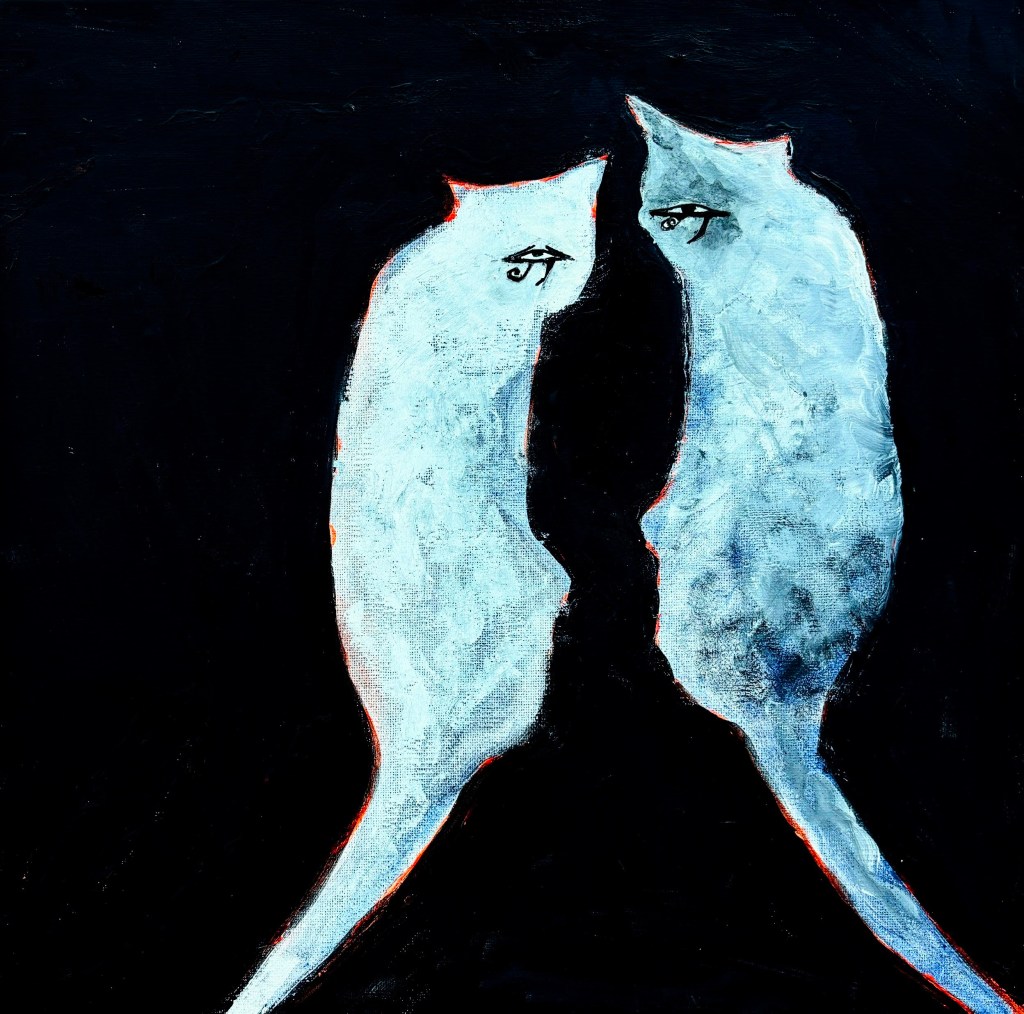
Quantum Cats – Artivive enabled
My background in psychological science drew on many of my own life experiences and helped me weave these into empathic clinical practices. All of this underpins my thinking about the work I do now and probably explains my tendency to hop from one set of ideas to another rather than pursuing a more sustained series. Difference is built into clinical practice because every client is different, and I see this not as short-termism, but the essential skill of seeing round corners and holding something in mind until it’s needed.
This degree is my artist’s full circle. A Foundation year dropout coming back after six decades to finish what I started and to integrate this with everything else that makes me me. I know more about how to look at things, how to see them, how to think and talk about them, and how to understand why I think something works or doesn’t. Objectivity is critical and the term ‘murder your darlings’, with which most writers are familiar, applies as much here as there. In short, I have a better sense of what it is to be an artist; integrating this into the toolbox of skills I’ve already collected is my next job, and I feel well-prepared to do it.*
824 words/750 +/- 10% (825) allowed excluding title and refs.
Acknowledgements
Huge thanks due to everyone who’s helped me along the way. It includes every tutor I’ve encountered, and Emma Drye who has headed up that team with empathy and insight. Of these, Clare (Wilson) has seen more of my work than anyone else and kick-started many a stalled creative engine. Worthy of the boom-tish of gratitude for a job well done and very much appreciated.
Bibliography
Bjorneborn, L. 2023. Adjacent Possible. In: The Palgrave Encyclopaedia of the Possible (pp 16-28). https://www.researchgate.net/publication/367416541_Adjacent_Possible
Hillis, N. ~2022. The Adjacent Possible in Art and Life. From her series The Artist’s Journey. YouTube https://www.youtube.com/watch?v=mvTc8RWp3Qc
Kaufman, S. 2024. The Adjacent Possible and how it explains Human Innovation. Video. 2024. https://www.youtube.com/watch?v=nEtATZePGmg
Pardoe, T. (1923) Language of the Body. The Quarterly Journal of Speech. 9 (3) 254. Pardoe noted that “mastering any art requires progressing from unconscious ignorance through conscious ignorance and knowledge, and then finally to a state where all required techniques have become unconscious knowledge.” This resonates with the current dialogue about adjacent possibles.
How Would You Beat? Podcast ~2022 discussing ‘The adjacent possible’ with guest Steven Johnson (Where Good Ideas Come From – Penguin 2020)
Additional information vis a vis the Pardoe reference is as given by Wikipedia.
*Apart from selling; I’m never going to like selling!
** Motion Leap, PhotoDirector, and PowerDirector.
 Strayfish Arts