Figure, form, and light: Rego, Vermeer, Lautrec, Schiele, da Vinci

Not yet a research point but as I came across it via the drawing module, I’m including some of the material here. Toulouse Lautrec – before the simplified nature of his posters (necessitated, I understand, by the printing process), his drawings were quite loose and almost cartoonish. There was a great deal of movement and energy, often with large numbers of characters and a focal individual. ‘La Danse au Moulin Rouge’ looks to me like a picture of spontaneous uninhibited fun. Egon Schiele – I envy the economy of line, and suggestion of form, but I am less keen on … Continue reading Figure, form, and light: Rego, Vermeer, Lautrec, Schiele, da Vinci

University of Brighton MA Show

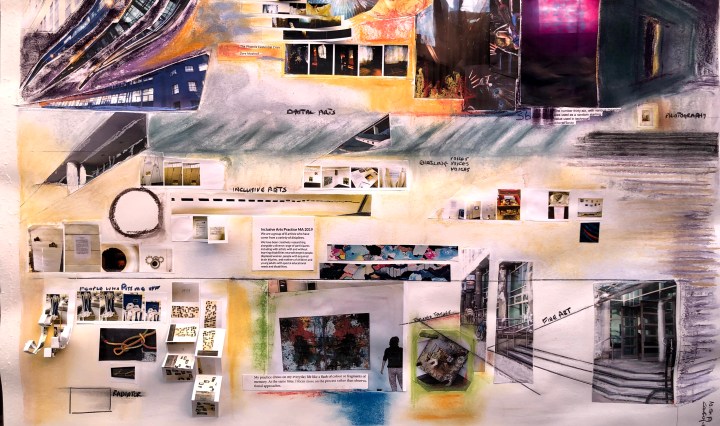
‘Podcast’ review via collage. The internal geography of the Grand Parade campus has changed since I was last there (1967-68) and so, inevitably, has the premise upon which art is made. At that time we were being psychedelic, free spirited, and often quite intensively introspective but to little purpose. Politics didn’t enter into our thinking.  But in this show, politics permeated everything that made its purpose clear; some of that personal, some social, and some encompassing global issues. Some gave us clues as to the raison d’etre of the work, the artist’s motivation or inspiration, their process and how it … Continue reading University of Brighton MA Show

Howard Hodgkin 1932-2017

One of his works features in the course materials, a vibrant and energetic piece that uses sweeps of complementary colours to evoke mood. The Bay of Naples is a 1980-1982 piece with a flattened perspective and expansive brushwork that makes the result anything but flat. It seems more abstract than figurative and somehow brighter than I would have expected, given it is painted on a dark ground. This one is similar; brilliantly impactful, a red frame bordering the ebullient fields of intense colour within. This image is from Mary Acton’s 2009 book, Learning to Look at Paintings, published by Routledge. … Continue reading Howard Hodgkin 1932-2017

Colour Theory

Introduction Colour theory has to do with both the science and biology of colour perception (by humans), and the psychology of it – what minds make of the information they receive. The originators, Goethe and Chevreul in the 19th century, seemingly coming to it from quite different perspectives, provided the working principles by which artists could actively choose colour combinations for their impact rather than relying on instinct. This is from Wikipedia which aggregates the bones of the subject: …two founding documents in color theory: the Theory of Colours (1810) by the German poet Johann Wolfgang von Goethe, and The Law of Simultaneous Color … Continue reading Colour Theory

Chiaroscuro

I came across the term chiaroscuro many years ago and subsequently forgot what it meant then confused it with sgraffito. A little analysis would have clarified that, given the latter’s close approximation to graffiti. Chiaroscuro is about light and the use of paint to create that illusion on canvas. Sister Wendy Beckett (Beckett, 2001) notes an early example of this (see above) and makes the link back from this Roman piece to Hellenistic art. I find this painting startling in its realism; representational without being frozen. It looks alive. The small glass vase in particular has a fragility to it, and a … Continue reading Chiaroscuro

Washes – a video by Liron Yanil

This was a revelation and really supported the course materials. Details such as the ideal tilt, and brush shape that aren’t covered in the text, and the concept of the bead – that leading edge of dilute medium that sits at the bottom of any horizontal stroke – which I’d never heard of and had no idea of its actual use. Liron is using watercolour but I need to try it with acrylics. My guess is it will dry more quickly but we’ll see.   First attempts, some with stretched paper and some not. These are prussian blue and raw … Continue reading Washes – a video by Liron Yanil

Research point, Part 2, colour theory

Introduction Colour theory has to do with both the science and biology of colour perception (by humans), and the psychology of it – what minds make of the information they receive. The originators, Goethe and Chevreul in the 19th century, seemingly coming to it from quite different perspectives, provided the working principles by which artists could actively choose colour combinations for their impact rather than relying on instinct. This is from Wikipedia which aggregates the bones of the subject: …two founding documents in color theory: the Theory of Colours (1810) by the German poet Johann Wolfgang von Goethe, and The Law of Simultaneous Color … Continue reading Research point, Part 2, colour theory

Part 1, Research Point 1, Chiaroscuro

I came across the term chiaroscuro many years ago and subsequently forgot what it meant then confused it with sgraffito. A little analysis would have clarified that, given the latter’s close approximation to graffiti. Chiaroscuro is about light and the use of paint to create that illusion on canvas. Sister Wendy Beckett (Beckett, 2001) notes an early example of this (see above) and makes the link back from this Roman piece to Hellenistic art. I find this painting startling in its realism; representational without being frozen. It looks alive. The small glass vase in particular has a fragility to it, and a … Continue reading Part 1, Research Point 1, Chiaroscuro