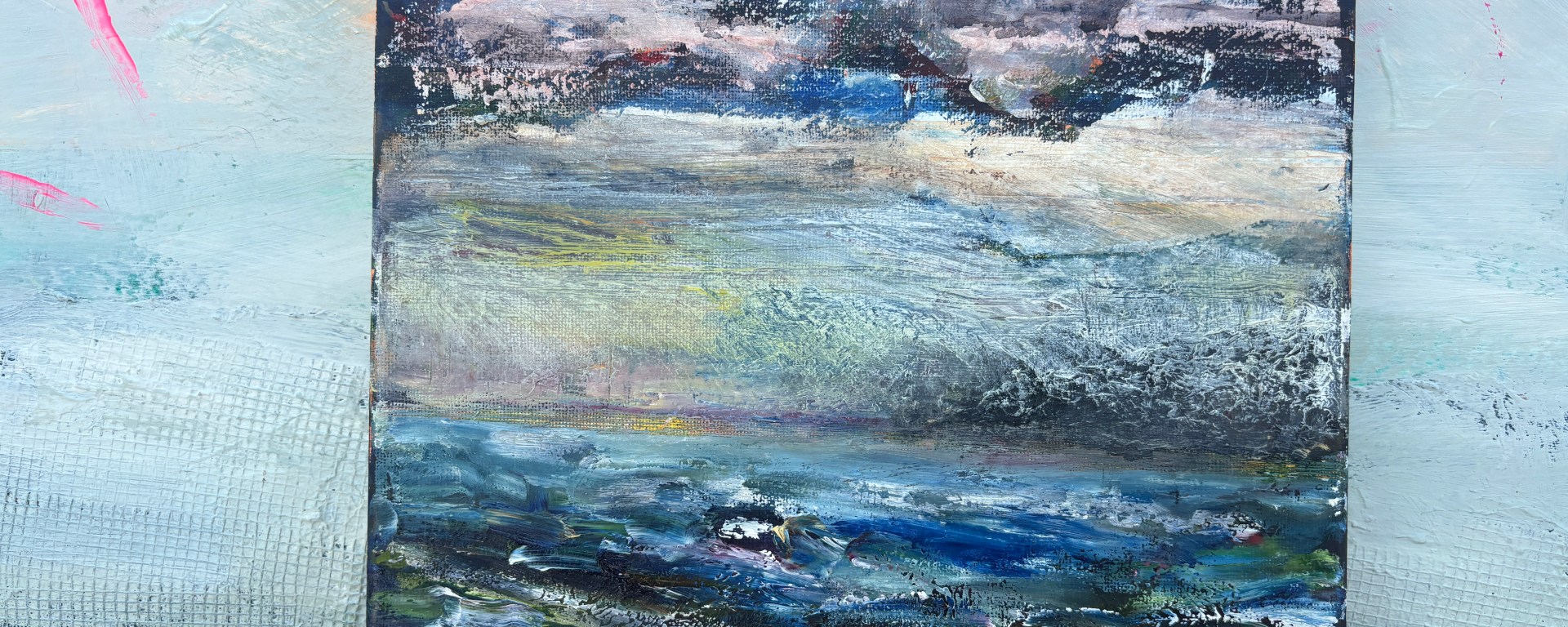
This started out as plants.
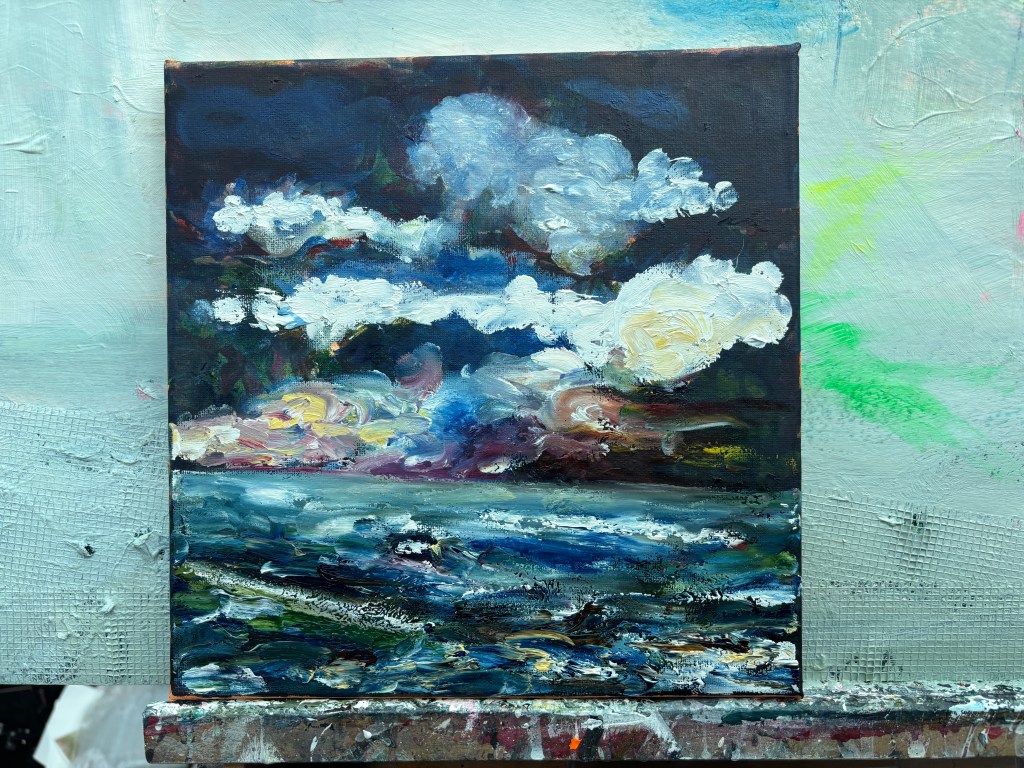
Became an unspecified seascape.
Acquired an air-borne sea mammal.
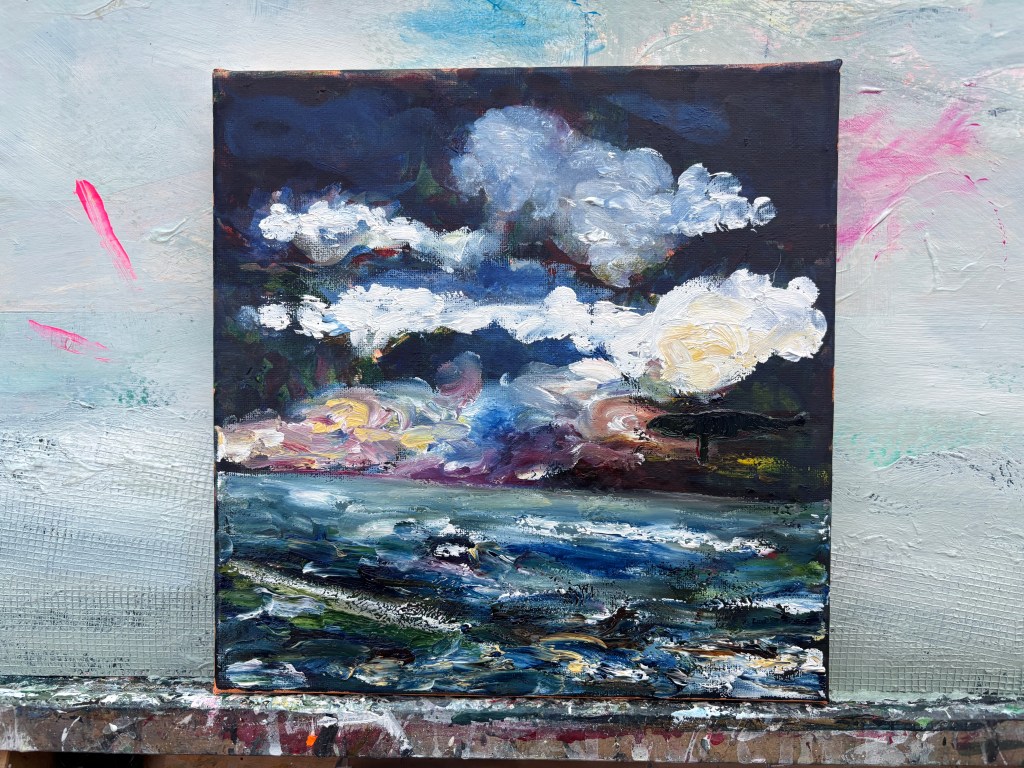
And then a time-lapse skyline.
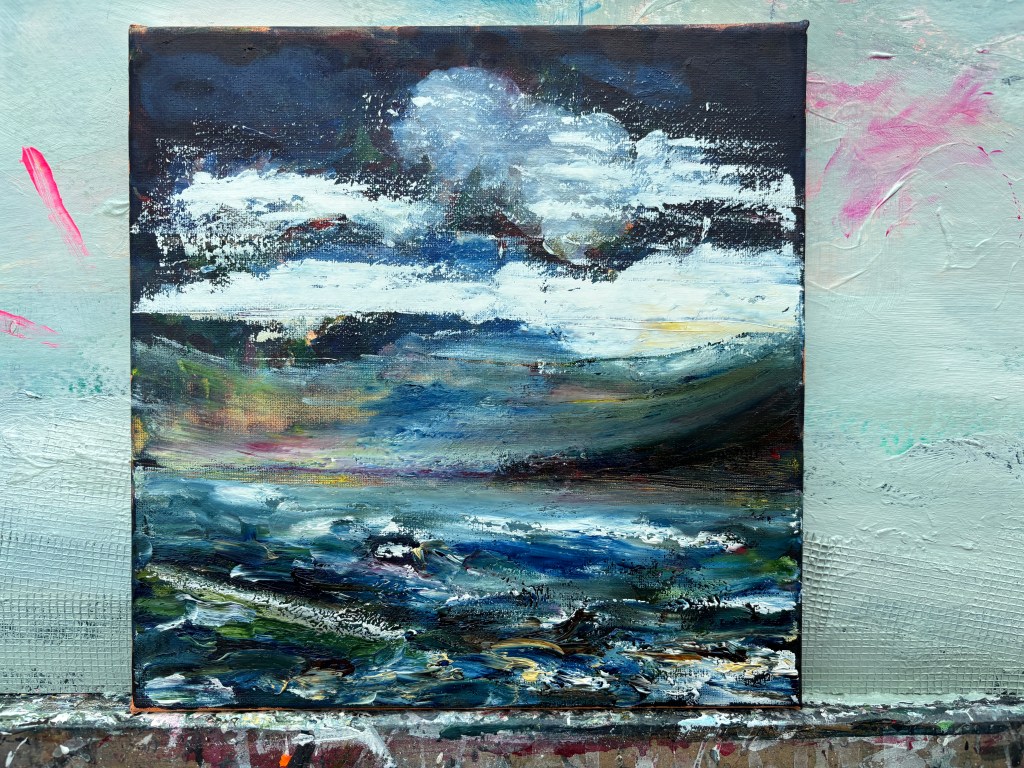
I’ve reached the point here where I have an image but no narrative, and without the narrative, there is no life. It will be there somewhere because my paintings tend to grow their narrative as they develop. Crucially, I have to leave them alone and just look at them until I see what’s there.
Oh dear, right now I’m looking at an open tin of sardines and a massive slug. Or a sting ray head-on.
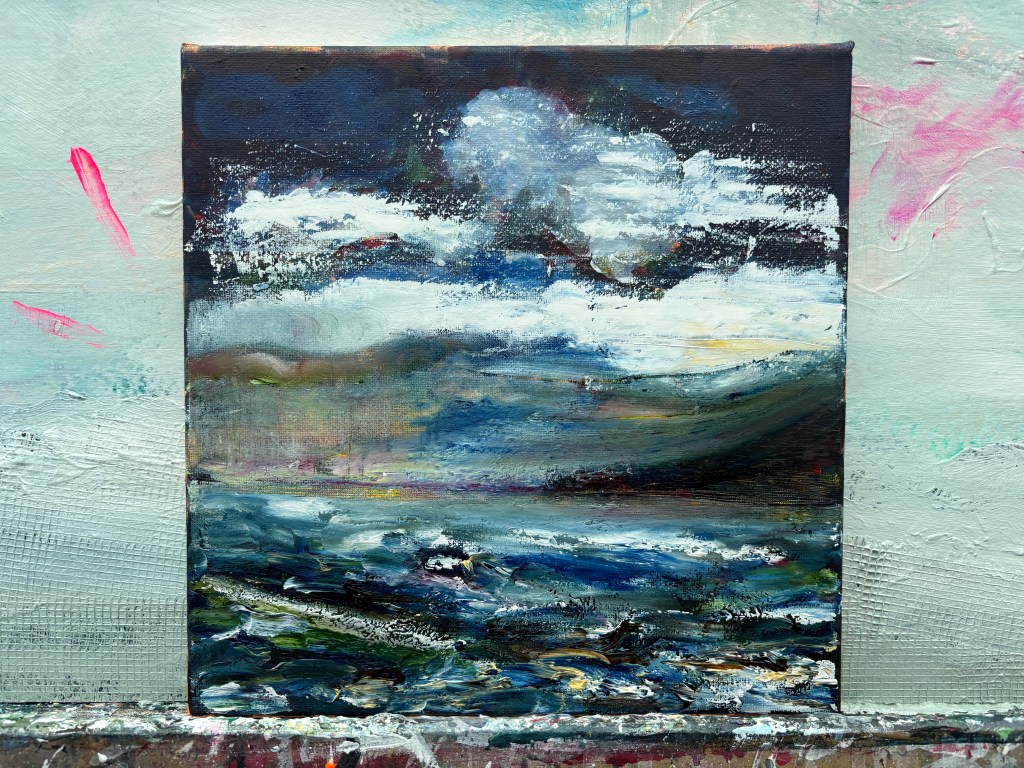
This was last night. I’m rather prone to having a dabble in the half-light and quite often it works. This time I’m not convinced, which means no, it didn’t. I’ve exchanged one slug for another, but it’s remediable, and I like the small smudge of highlight in the brownish base of the cloud on the left. I’ve also spotted a boat in the centre lower third, heading out towards the storm. I think I need to darken the base of that cloud, or at least reduce the sharp definition between that area and the white/grey above. The area that’s become a hillside on the right needs some attention too, but I’m not quite sure what. Definitely not silhouettes of trees on the skyline or the cosy orange lights of a wee cottage nestling, as they always do, near the coast.
An incidental note for anyone reading this and wondering who it’s for: I’ve found, through this course, that there’s nothing quite like conducting and documenting a visual analysis of a painting for permitting an internal conversation with myself about the visual impact, composition, and execution of a piece of work and then writing objectively about it for bringing up points I wouldn’t otherwise notice. It’s a sympathetic critique which can result in actions up to and including scraping the lot off and starting again, no matter how much I might have liked it. The writers’ maxim, murder your darlings, exemplified. As to who it’s for I’d say someone who likes colour, who ‘feels’ texture, who’s a little bit paradeolic, who likes a hint about its meaning but wants to find their own story in it. Children do this unselfconsciously.
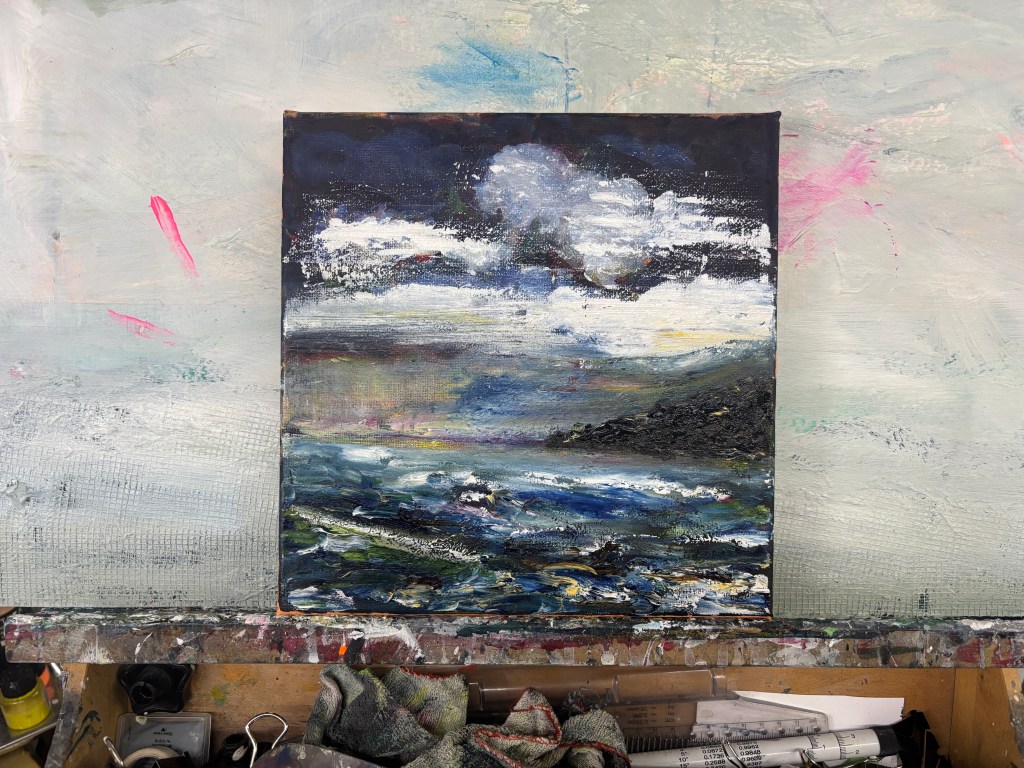
The hillside is a little less smooth although whether or not it will stay that way depends on how my preference balance tilts – towards slightly surreal or towards not quite representationally real. There does seem to be a massive tubular water-going entity in the bottom left corner which probably needs dealing with. Is it leaving the shore or arriving?
At the root of this painting is the palette used by Hurving Anderson which features strong, deep colours and tones. His work is tidier and less lumpy (which, once I graduate, I’m obliged by law to refer to as impasto).
19th June 2026. WordPress lost an entire paragraph here. Naturally, it was brilliant. This is its fading echo. There has been a lot of layering, scraping, and scrubbing in this painting. I’ve layered on clouds, splattered them, and scrubbed them out of shape. The rhythm of the sea, whether water or some other element in liquid form, is also disrupted. The horizon shows near-vertical travel of liquids and solids following an air-borne current, and the space just above the horizon has been cleared by this process to reveal a source of light. As usual, the physical work has given rise to the imagined scenario, in this case, a reversal of gravity, which would happen, (and does in some parts of our solar system*), should a large enough body come close enough to another to exert gravitational influence. Here, the lighter elements, seen towards the horizon, are moving against normal pressures. The boat, as yet, is unaffected. This place supports intelligent life, but I’m not sure if it’s us.
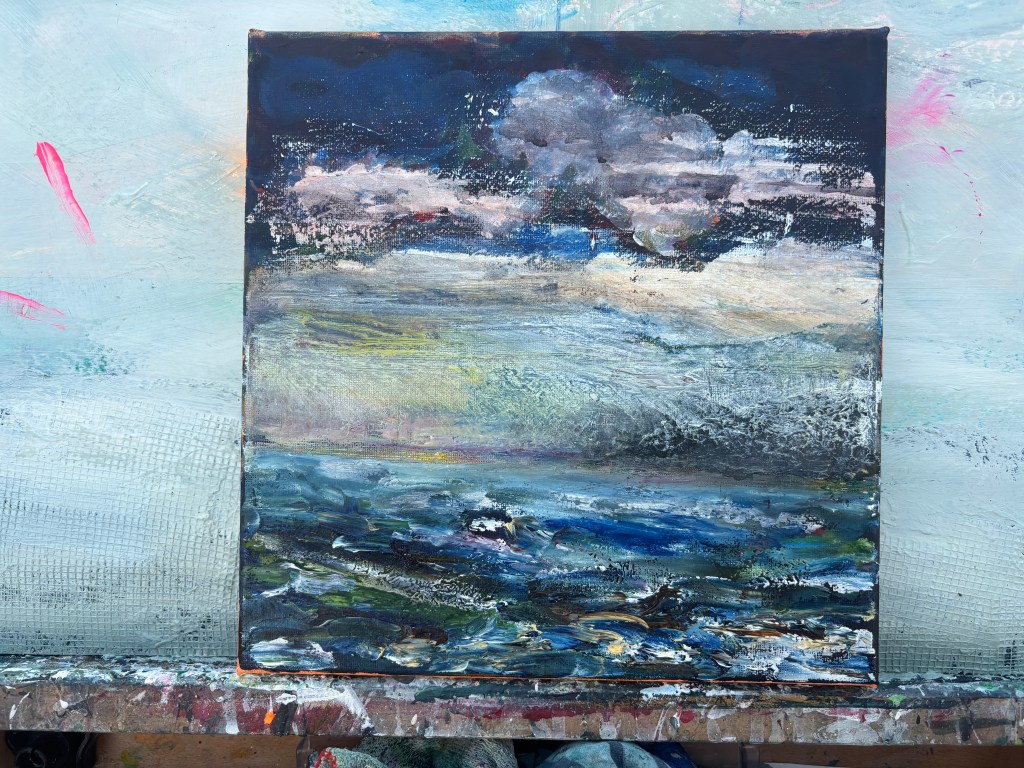
Rising Weather. 2026. Water soluble oils on 24x24cm canvas.
© Suzanne Conboy-Hill 2026
*Our own moon does this, affecting tides in particular https://www.iop.org/explore-physics/moon/how-does-moon-affect-earth. For many other moons, Enceladus for instance, the impact goes the other way https://www.youtube.com/watch?v=jTo42mwzOPs&t=291s.
 Strayfish Arts