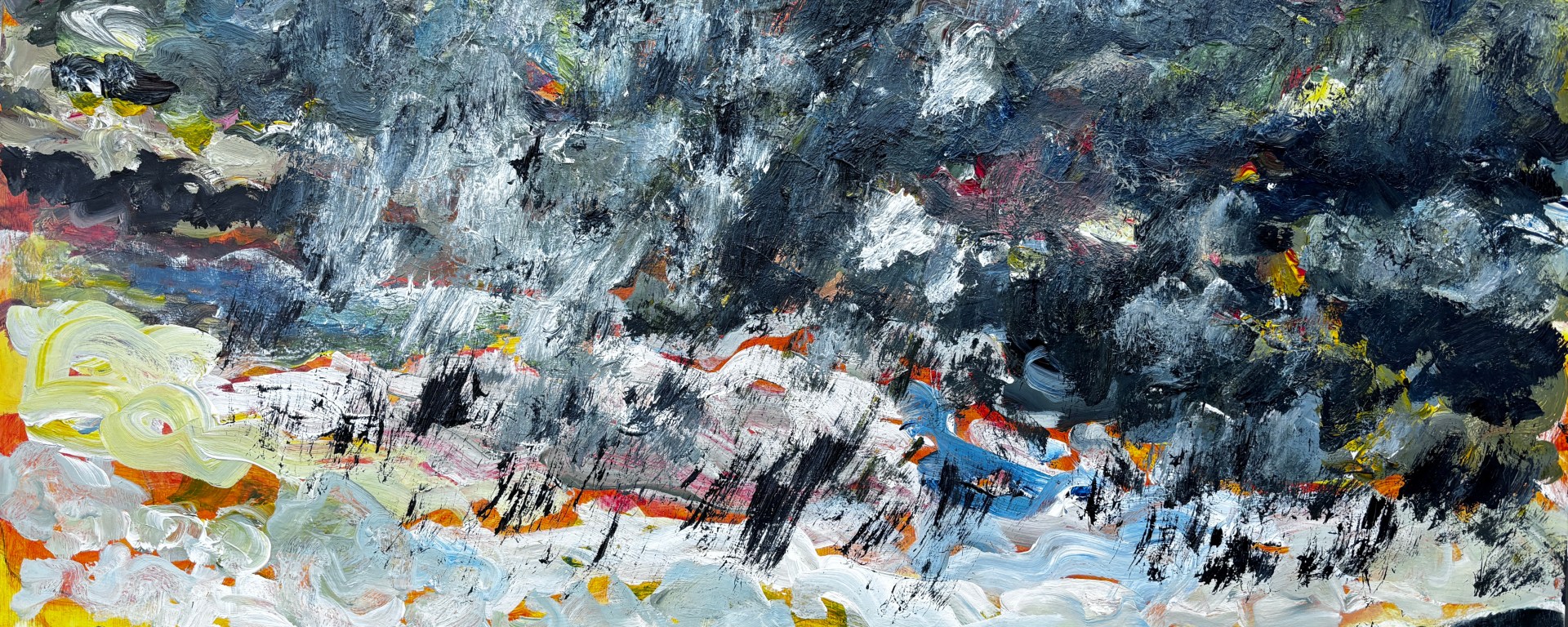
Or maybe Storm. Instagram may have a view.
As always, this draws from rather than reproduces one of the many photos I’ve taken of systems like this approaching the village. I prefer to think of it as making a painting about something, not of it. This gives me licence to deal with colours differently and here, as the painting progressed, I’ve found myself bringing out the energy of the storm in brushwork and flashes of colour not generally visually present.
I didn’t know this at the outset though because as usual, I’m led as much by the painting as it develops as by the subject matter. At one point, I tried to force it to accommodate a cat in the clouds in the manner of a deliberately constructed prompt for pareidolia but, mercifully, it was having none of it.

I’m using acrylics mixed with gloss varnish on a base of white acrylic gesso also mixed with gloss varnish, applied to A1 white card. The varnish gives the paint a slipperiness that permits the kind of transparency visible in the dark greens at the bottom of the painting, and I can make looping shapes with the brush to create movement. I didn’t touch this area at all thereafter, with the exception of placing some reflective orange onto the river’s surface.

The colours at this point are deepening, although I’m trying to retain the transparency of those first applications in the lower mid-ground. This is a massive challenge to my willpower which has failed me so often and leaves me preferring an earlier version of something to the finished article.

This is probably the point at which I ‘saw’ the cat – green and in the top left quadrant – and spent hours trying to pull it out, push it back, make it bigger or smaller, a different shape, anything at all that would justify its presence as a cloud-shifter.
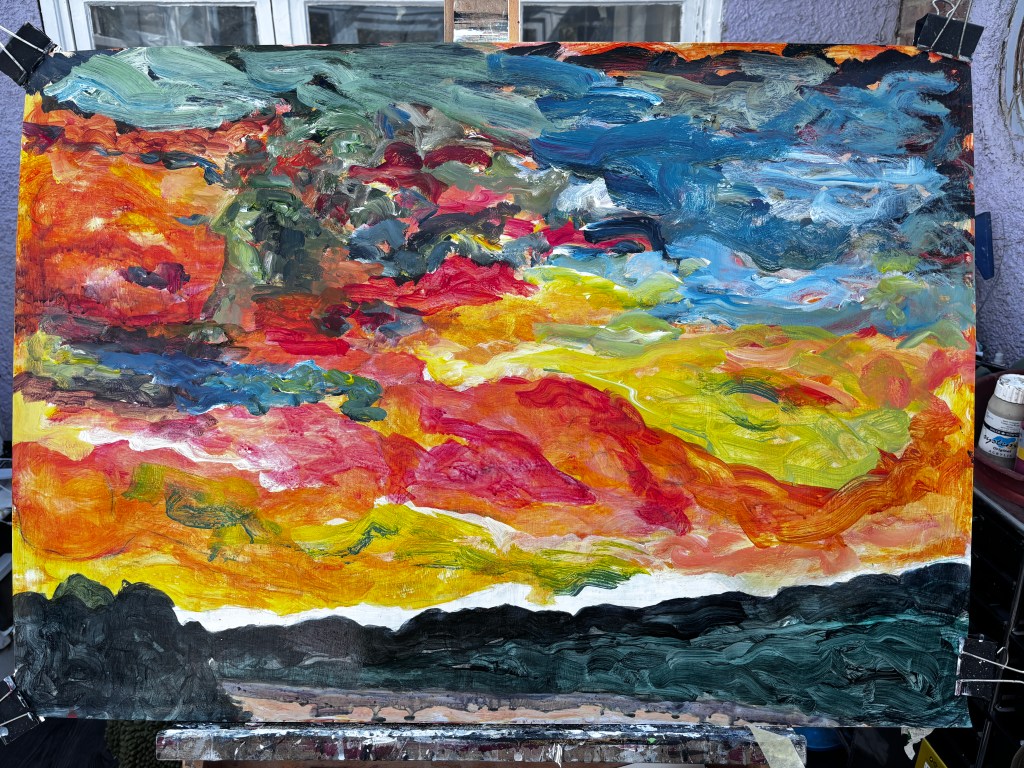

Below is where I abandoned the stultifying cat idea and scrambled paint across the whole surface. It has energy, but that’s about all.

Then suddenly, out of nowhere and with the help of a scrappy old brush that’s just merited a reprieve from being binned, a whole new perspective emerged and it was one I recognised – a storm.

The brushwork pushes and pulls at wet paint; hauling the clouds beneath the storm briefly into view then masking them in black thunder. To me, the raw slashes of black said more about storms than true-to-life rainfall would. It feels heavy and sharp and best avoided. This was the stopping point. Image #2 comes a close second for its looseness, transparency and even some of its shapes, but it didn’t really speak to me and in the photograph, it’s benefiting from shade due to the sun’s position being high up behind the roof of the house.
The final version, its photo very close to my direct experience, surprised me with its energy, all of which came in a few final minutes following the post-cat drought. Critically, I don’t think it could have happened without the preceding layers. To my mind, and that slippery unconscious bubbling beneath, we were building its narrative, the raison d’être, that permitted the crescendo of the final layer.

Digital layers to come.
All elements; text, images, concept; are (c)Suzanne Conboy-Hill 2025. AI trawling is prohibited.
 Strayfish Arts