
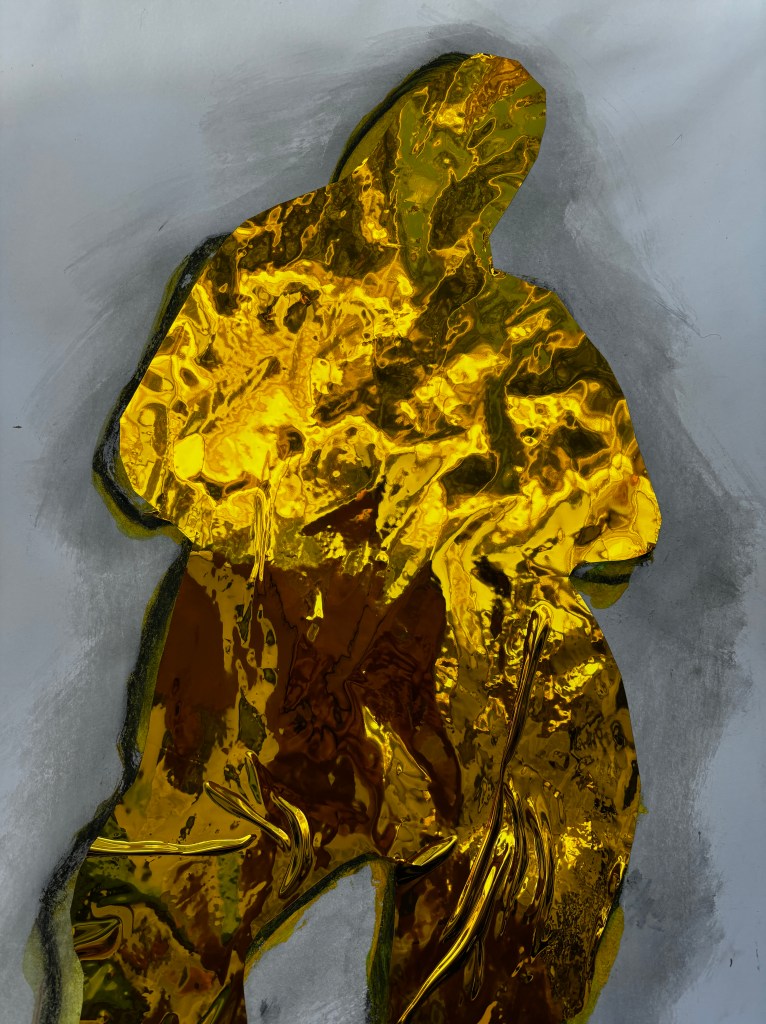
Well, doesn’t this have potential! The gold vinyl foil is quite substantial and has will power to match so it’s quite a handful to manipulate. But, the drawing done on an A1 sheet of cartridge, I painted the outline then pressed the back of the foil (the covered part) onto the wet paint to make an outline I could follow with scissors, cut out the shadow shape, and finally stuck it onto the cartridge using its own sticky back surface. It looks like something from a moon lander.
Tomorrow I’ll think about the surround – are we going for the black of space or the bright white of a supernova?
It’s the 11th of May, 2025 and after going through a large number of photos yesterday to ensure I hadn’t accidentally submitted one that had been adjusted (I do this primarily to compensate for shine on black paint) I thought about rock solid ways of establishing provenance. One obvious method is to take photos of every stage of a painting’s progress and post it on the learning log. This I do and so everything is there, warts and all, apart from the odd time when I’ve got into the painting without remembering to photograph the earliest stages. Another way would be to repurpose one of my Blink cameras from wildlife watching. These are motion-activated and so capture a quick burst of anything that moves. I put two in my studio today and if the result isn’t incontrovertible evidence of provenance, I’ll need a hat to eat. I’ll make a short summary video from the 100+ clips then adjust the camera settings to increase the delay between captures.
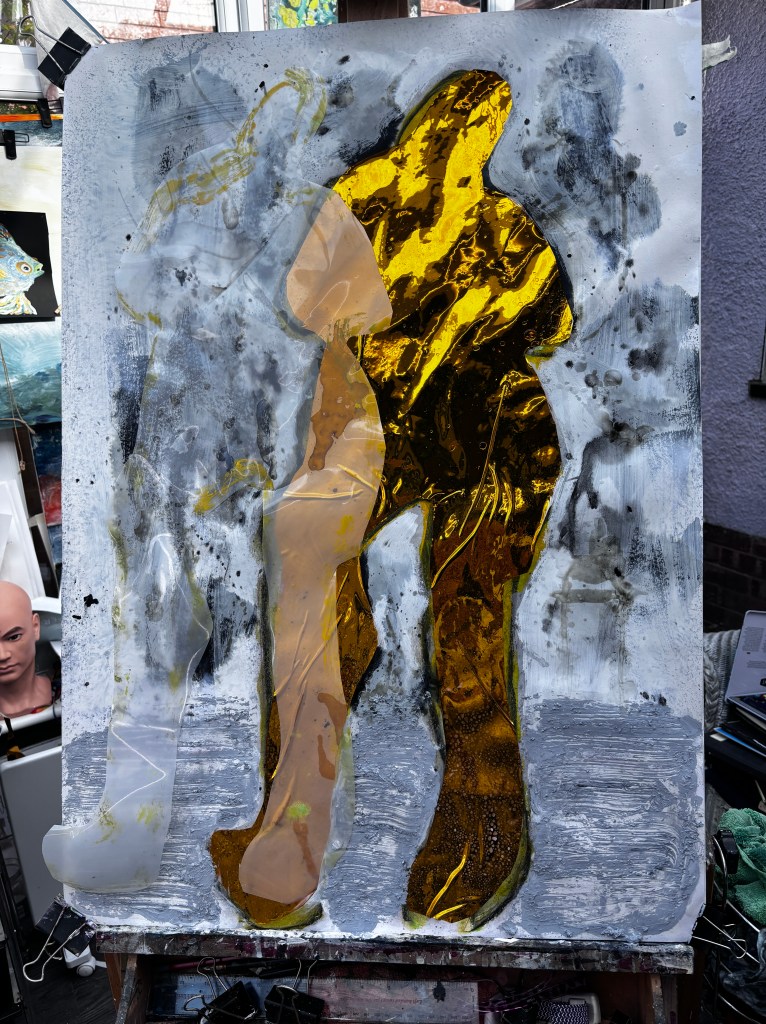
Above, the semi-transparent figure is the backing material from the gold foil. I’ve used pumice gesso in the bottom 1/4, anticipating a lunar scene. The paint application is dilute Payne’s Grey over splashes of gloss varnish. This is enhanced by the deepening and solidity of the colour (below).
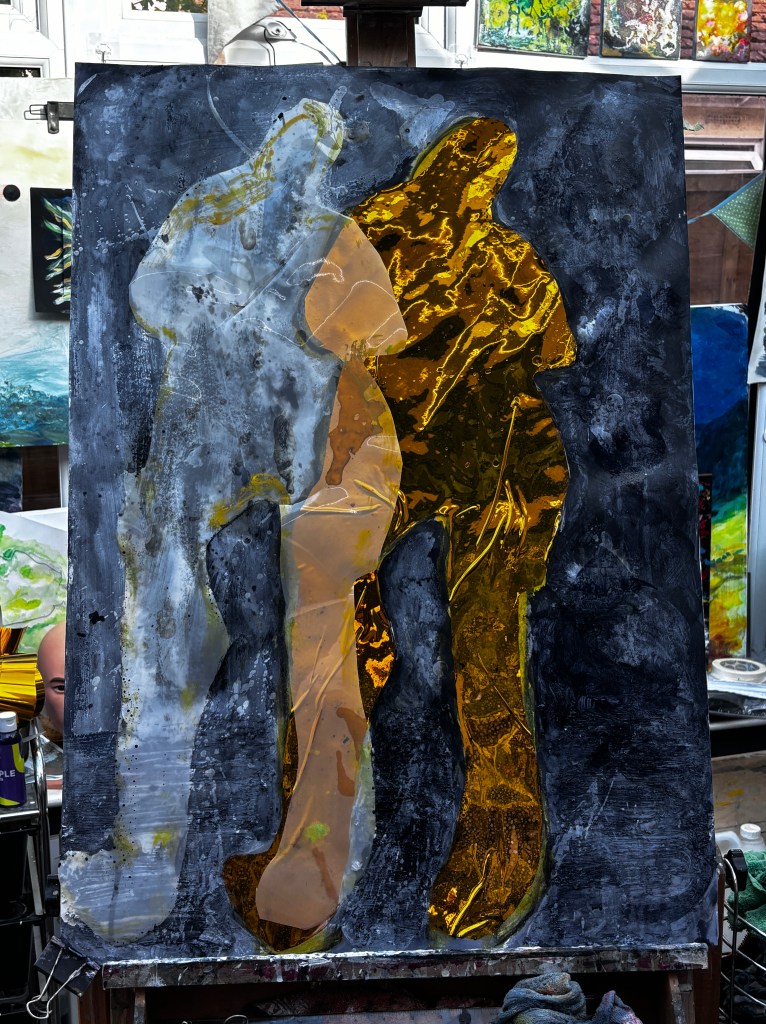
I never know quite how paintings are going to develop because I don’t lead, I follow.This is a cognitive, operational strategy and nothing to do with muses, instead it acknowledges the critical role of unconscious processing in creative events. Briefly, we take in a great deal of information throughout our lives, only a small amount of which conscious processing can handle at any one time. Its nature is to be linear and relatively uni-directional, like a sentence, so it has little room for peripheral issues. These are managed by unconscious processing which I like to characterise as a bubbling cauldron of ideas and information, some very close to the linear material and some wildly distant from it. These it lobs up onto our linear conveyor belt and we incorporate it into our expression. The wild stuff is held back for times we’re not thinking or making sentences. We’re free-wheeling on a walk, on a park bench, doing nothing, doing the washing up. This is when the wild ideas have their chance to get an audience with us. Some people call it day-dreaming and think it’s for time-wasters. It isn’t.
This painting/collage began with a large gold cut-out of a hand-drawn shadow and no plan for what would come next. The golf foil evoked space travel. Space travel gave me faint moons and stars, star nurseries (the points and patches of varnish), and the assumed blackness of space. The foil has the advantage of being visually mobile itself as it reflects whatever is in front of it, and so photographs of it can be markedly different just because of a slight change of camera position.
(c) SCH
While it may appear like gold, MLI is made of relatively inexpensive materials like aluminized Kapton and Mylar. https://www.azom.com/article.aspx?ArticleID=24380
In essence, MLI provides a crucial thermal shield and radiation barrier for spacecraft, helping them to operate reliably in the harsh environment of space. https://en.wikipedia.org/wiki/Multi-layer_insulation
 Strayfish Arts